The Best Ways to Track Basketball Stats for Coaching Success

As a basketball coach, you're constantly looking for an edge. You dedicate countless hours to practice planning, skill development, and game strategy. But are you truly maximizing your team's potential?
One of the most powerful tools in your arsenal is data. Tracking stats allows you to move beyond gut feelings and make informed decisions based on concrete evidence. It provides insights into player performance, team strengths, and opponent tendencies. In this guide, we’ll explore the best methods to track stats and how to transform that data into wins.
Why Track Basketball Stats?
Before we dive into methods, let's solidify why tracking stats is essential. It goes far beyond simply knowing who scored the most points.
- Objective Evaluation: Stats offer an unbiased view. Instead of relying on memory, you see how players perform in high-pressure situations.
- Identify Strengths & Weaknesses: Pinpoint why you are losing. Are you struggling with defensive rebounding or transition defense? The numbers don't lie.
- Player Development: Use stats to set concrete goals and track progress. It’s much easier to motivate a player to improve when you can show them their actual percentages from different spots on the floor.
- Opponent Analysis: Scout opponents and identify their tendencies to develop game plans that exploit their specific weaknesses.
- The "Video Connection": Modern tools, like CourtSide Stats, allow you to bridge the gap between a number on a page and the action on the court by tagging film directly as you track.
Methods for Tracking Basketball Stats
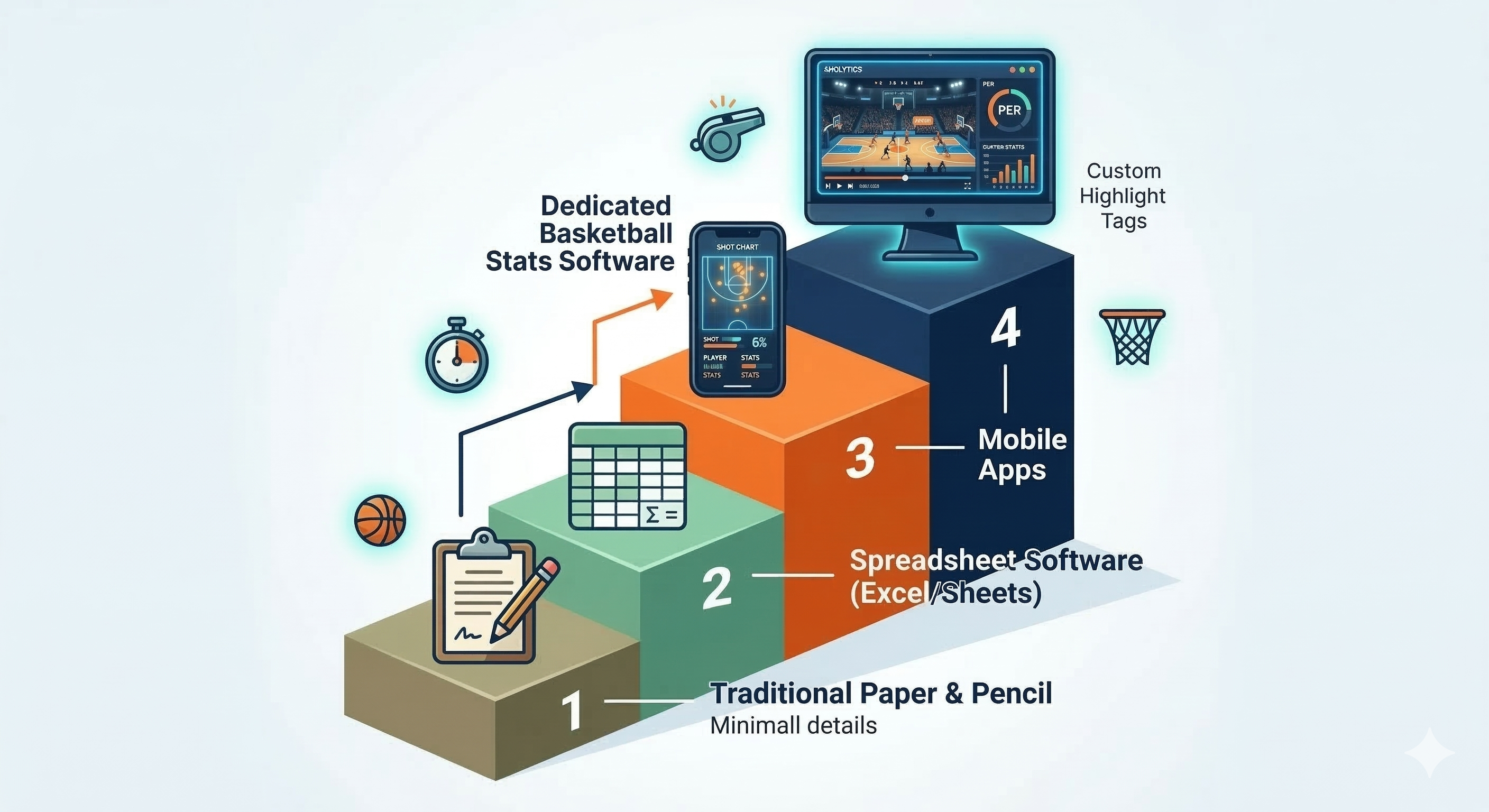
There's a spectrum of methods available. The best choice depends on your resources and the level of detail you require.
1. Traditional Paper and Pencil
The Entry Point The most basic method involves manually recording stats using a scoresheet.
- Pros: Inexpensive, no battery required, easy for anyone to start.
- Cons: Extremely time-consuming to aggregate. It’s nearly impossible to calculate advanced metrics or identify trends mid-game.
2. Spreadsheet Software (Excel, Google Sheets)
The Digital Organizer
- Pros: Formulas can automate totals and percentages. It’s a great way to keep a historical record of a full season.
- Cons: Still requires manual data entry after the game, which can be tedious for a head coach.
3. Dedicated Basketball Stats & Video Software
The Professional Standard This involves platforms designed specifically for the sport, often integrating video analysis.
- Pros: Real-time advanced analytics (PER, Plus/Minus), shot charts, and—crucially—video integration.
- The CourtSide Advantage: Instead of just seeing "15 turnovers" in a box score, you can click a button and watch all 15 turnovers instantly. This saves coaches hours of film study.
- Cons: May require a tablet or laptop and a small learning curve.
Key Basketball Stats to Track
Basic Stats:
The fundamentals: Points, Rebounds, Assists, Steals, Blocks, Turnovers, and Fouls.
Advanced Stats:
To get a deeper look at efficiency, use these formulas:
- Effective Field Goal Percentage (eFG%): Adjusts for the fact that a 3-point shot is worth more than a 2-point shot.
- True Shooting Percentage (TS%): The ultimate measure of shooting efficiency, including free throws:
TS% = Total Points / [ 2 x (Field Goal Attempts + 0.44 x Free Throw Attempts) ]
- Assist-to-Turnover Ratio: A vital metric for point guards and team ball security.
Situational Stats:
- Points Per Possession (PPP): How efficient is your offense every time you touch the ball?
- Points in the Paint: Indicates interior dominance.
- Second Chance Points: Measures the impact of your offensive rebounding.
Tips for Success: Avoiding "Analysis Paralysis"
One of the biggest mistakes coaches make is trying to track everything. This leads to "analysis paralysis," where you have so much data you don't know what to do with it.
- Pick your KPIs: Choose 3–5 Key Performance Indicators that match your coaching philosophy (e.g., Defensive Rebound %, Turnover Rate, and PPP).
- Be Consistent: Use the same definitions for every game.
- Use Video Analysis: Statistics tell you what happened; video tells you why. Supplementing your stats with a tool like CourtSide Stats allows you to see the context behind the numbers.
- Communicate Clearly: Don't drown your players in spreadsheets. Show them one or two key charts or video clips that prove your point.
Conclusion
Tracking basketball stats is an essential part of modern coaching. Whether you start with a simple clipboard or upgrade to an integrated video and data platform, the goal remains the same: to make better decisions for your team. Start small, be consistent, and watch how data transforms your coaching.